Category Archives: Righteousness

Tell and Show

In truth, it’s not what you say that matters; it’s what you do.  That’s the test.  It’s not enough to sound religious, to say a bunch of holy things about God and stuff.  It’s what you do that shows if you are spiritually alive.

“If anyone considers himself religious and yet does not keep a tight rein on his tongue, he deceives himself and his religion is worthless. Religion that God our Father accepts as pure and faultless is this: to look after orphans and widows in their distress and to keep oneself from being polluted by the world. “ (James 1:26-27)

At first glance it sounds like James is saying, “Hey, watch your language around here, buddy…” But really, he is warning people not to sound religious to impress others or maybe even God.  People may be fooled by that, but God isn’t impressed with lofty tones of voice and holy vocabulary.  He cares about what He sees us do.  Don’t misunderstand: we can’t earn our way into God’s favor with good works.  But when we have His Spirit alive within us, we will show it as we tend to help others in distress.  Even those like widows and orphans who, in that day, didn’t count for much.  “Being polluted by the world,” in this context, means caring more about my own reputation among the influential people than I do about someone else with real needs.

These two verses drag me across coals of regret. I wince to read about keeping a close rein on my tongue.  But that’s why I need these verses.  And why I need grace.

Quotes: The Holy Bible : New International Version. 1996, c1984 (electronic ed.). Grand Rapids: Zondervan.

Jesus and ISIS

How would Jesus tell us to respond to ISIS?  Should we turn the other cheek?  Love our enemies?  Pray and trust God will handle it?  Overcome evil with good?  Certainly Jesus taught all of the above.  However, we must also remember that Jesus:

  • Publicly identified evil and stood against it.

    “You brood of vipers, how can you who are evil say anything good? For out of the overflow of the heart the mouth speaks.” (Matthew 12:34, NIV)

  • Taught us not to turn away from the needy without helping.

    “For I was hungry and you gave me something to eat, I was thirsty and you gave me something to drink, I was a stranger and you invited me in, I needed clothes and you clothed me, I was sick and you looked after me, I was in prison and you came to visit me.’” (Matthew 25:35-36)

  • Commanded us to love one another and that the ultimate act of love is to lay down our own life for another.

    “My command is this: Love each other as I have loved you. Greater love has no one than this, that he lay down his life for his friends.” (John 15:12-13)

Jesus’ teachings are directed to us as individuals; they do not easily adapt to directing national policy.

But I tell you, Do not resist an evil person. If someone strikes you on the right cheek, turn to him the other also.” (Matthew 5:39)

However, we, as a nation, cannot pretend that “strategic patience” is Christlike or good.  We have:

  • Failed to clearly identify evil and oppose it.
  • Failed to help innocent people by providing what they need to defend themselves.
  • Failed to sacrifice our resources and lives out of love for the oppressed.

The day may come when we as individuals can reach out with goodness and love to those who have been our enemies.  The day may come when we can set aside our desire for retaliation and actively work for reconciliation.  Perhaps we may adopt these attitudes as a nation.  But it is wrong for us as a people to dither and do nothing as wicked people torture, enslave and murder others.

Quotes:  The Holy Bible : New International Version. 1996, c1984 (electronic ed.). Grand Rapids: Zondervan.

Thou Shalt Not

Two weeks ago, a toddler shot his mother and her boyfriend.  He found a gun in her purse and was messing around with it.  Ten days before that, a two year-old fatally shot himself with a gun he found in the glove compartment.  I’m not anti-gun; my son-in-law used a gun to protect his family from a rattler.  But anyone in his right mind would insist that his children not touch his guns. (He would also lock them up but this post isn’t about gun safety, it’s about loving rules.)  It isn’t being harsh for a parent to make strict rules about guns and enforce them.  It’s loving.  The kids may think you are spoiling their fun.  They may resent your rules and try everything they can to break them.  But the rules are loving, because you have made them to protect their lives.

The same principle holds true for God, Who is often perceived in a negative, kill-joy sort of way.  People say, “Why should we follow a bunch of rules laid down thousands of years ago by a mean-spirited, ignorant deity?  Let’s make up our own rules about what we can do.”  They resent God and decide to ignore what His rules.

But God says,

 “… ‘As surely as I live, declares the Sovereign Lord, I take no pleasure in the death of the wicked, but rather that they turn from their ways and live. Turn! Turn from your evil ways! Why will you die, O house of Israel?’” (Ezekiel 33:11b)

God loves you.  He wants you to live.  Remember that the next time you feel like breaking one of His rules.

PS:  CHECK OUT THE NEW DOWNLOAD PAGE AT THE TOP!

Quotes: The Holy Bible : New International Version. 1996, c1984 (electronic ed.). Grand Rapids: Zondervan.

Better Bread

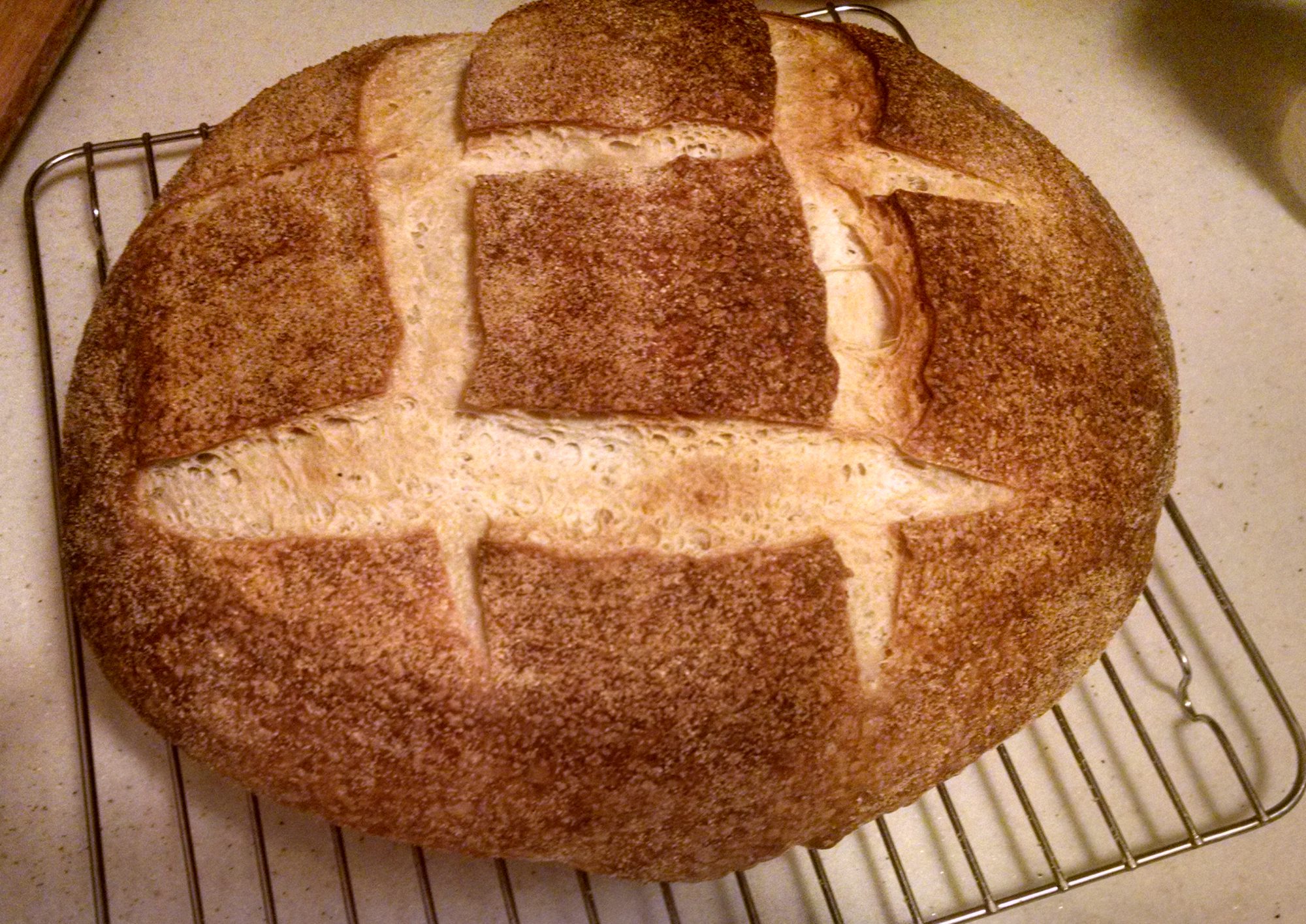
When you sink your teeth into good sourdough, the crust fights back a little; it’s chewy and a bit tough.  Making bread has been a hobby of mine for years and I’ve developed methods that work pretty well. But when I spotted a used copy of Peter Reinhart’s “Crust and Crumb” down at Barbwire Books, I snatched it up.  Peter writes about how to make “world class bread,” bread that is “good beyond belief.”  When I read that line, I had to have the book.

I keep “Crust and Crumb” by my easy chair and frequently browse through it, absorbing what he has to say. Peter’s recipes were very much like the ones I had been using.  But he spends most of the book describing specific ways to form and handle the dough.  Some of those methods require several days to make a batch of bread and seemed unnecessarily tedious to me.  So, I modified his methods with a few personal shortcuts here and there. My sourdough was improved somewhat but was not yet “good beyond belief.”  In reflecting on what was wrong, it occurred to me that perhaps I’d get better results if I actually followed Reinharts instructions. (Duh!)  Last time I made sourdough, I followed his methods to the letter.  Oh my goodness…  Not yet good beyond belief but it’s getting there…

It’s very easy to make the same mistake with the Bible – keep it by the easy chair, browse through it and modify what it says to suit what seems doable.  Throw in a personal shortcut here or there.  Here’s what Jesus’ brother Jim said about that:

“Do not merely listen to the word, and so deceive yourselves. Do what it says. Anyone who listens to the word but does not do what it says is like a man who looks at his face in a mirror and, after looking at himself, goes away and immediately forgets what he looks like. But the man who looks intently into the perfect law that gives freedom, and continues to do this, not forgetting what he has heard, but doing it—he will be blessed in what he does.” (James 1:22-25, NIV)

Just do it.  Like the bread, you won’t be “good beyond belief” but you’ll be heading in that direction.

Quotes: The Holy Bible : New International Version. 1996, c1984 (electronic ed.). Grand Rapids: Zondervan.