
Tag Archives: God

When You’re Ready

My wife and I got mugged in Savannah, not physically but verbally, by a guy holding a sign and yelling Bible verses at us.  He literally followed us down the street, trying to “save” us by forcing Scripture on us.  He probably thought he was earning brownie points from God.  I was annoyed.  More than that, I was frustrated, wondering how many people he had chased away from God’s grace that day.  If you get accosted by someone shoving God or the Bible down your throat, don’t fight back; run away.  Because God doesn’t work that way.

It’s not that God doesn’t care; He really does.  Jesus’ brother, James, wrote of how God intensely yearns for His Spirit to live in us, just as He intended.  (That is my rough and loose paraphrase of James 4:5)  God is passionate that we be restored to the fullness of spiritual life by having His Spirit alive in us.  He wanted that for us so much He paid a terrible price to accomplish it.

BUT HE DOES NOT FORCE HIMSELF ON US!  He waits for us to be ready.  James continued his thought with this:

“But He [God] gives us more grace. That is why Scripture says: “God opposes the proud but gives grace to the humble.” (James 4:6 – my explanation in brackets)

“The proud” in that verse are those who think they have life figured out on their own and who have no use for God.  He waits.  Stuff happens.  Sometimes “the proud” become “the humble.”  In the words of Bob Dylan (Like a Rolling Stone)

You used to laugh about
Everybody that was hangin’ out
Now you don’t talk so loud
Now you don’t seem so proud
About having to be scrounging for your next meal

When “the proud” become “the humble,” when they are ready to receive Him, then God approaches.  With grace.  Not with loud, angry shouting.  He sent His Son to find you and rescue you.

“For God did not send his Son into the world to condemn the world, but to save the world through him.” (John 3:17)

Jesus invited people to come to Him and find rest, saying He was “gentle and humble in heart.”  (Matthew 11:28-30)

I remember seeing a video on Facebook about a guy who rescued an abandoned, starving dog.  The dog was aggressive, unwilling for anyone to approach but the guy just sat there and waited him out.  After a long time, when the dog was ready to receive it, the man gave him “more grace” – care, nourishment, healing and a new life.  There was no yelling involved, no signs, no scolding.  It was very much like my own experience with God, Who waited until I was not so full of myself.  Then, when I was ready to receive His grace, without holding anything against me, He gave me the life of His Son, Jesus.

He waits for you, too.
Quotes:  The Holy Bible : New International Version. 1996, c1984 (electronic ed.). Grand Rapids: Zondervan.
Like a Rolling Stone lyrics: http://www.bobdylan.com/us/songs/rolling-stone#ixzz3UwbEdylf

Your Choice

Perhaps you have noticed the plaster dust?  “Fresh Bread of Life” is being remodeled.  We have recently posted “The Inside Story,” an audiobook with 67 audio messages about the Gospel of John.  You now have two choices for listening to this material:

  1. You can DOWNLOAD the whole book to listen at your convenience.
  2. You can listen to each message separately by STREAMING (no download necessary).

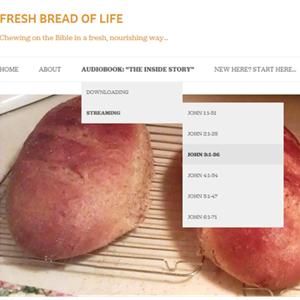
Click on the AUDIOBOOK button in the menu at the top of this page and the two options will drop down.

  • If you select DOWNLOAD, you will be directed to a page on which you will choose which format to use – Windows or iOS.
  • Because the download is so large (350 Meg) you may prefer to choose STREAMING. When you click on STREAMING you will then see links to each chapter of John.  Each of these have a few audio links arranged by the verses in that chapter.

For example, suppose you wanted to listen to a message about John 3:16.  First click on “AUDIOBOOK” at the top of the page and then on STREAMING from the drop-down menu.  Click again on John 3:1-36.  Menu Drop Down On that page, the second message, “What’s it Worth?” is about the passage beginning with John 3:16.  You start the audio by pushing on the arrow on the sound bar.

Menu Drop Down 2

Give it a try.  All the messages are not posted yet, but will be soon.  If you have problems or questions, please be sure to let us know…

Be a Real Tomato

Ever picked a tomato out of your garden and chomped down on it right away, letting the juice run down your chin?  Remember the incredible explosion of taste?  I challenge you to repeat that experience with any tomato you find at the store.  The primary motive of those who grew tomatoes for the store was making money not developing taste.  In the eyes of business, it takes too long to let a tomato grow naturally.  It’s too expensive to grow tomatoes for deep rich taste.  They work for tomatoes that look good, don’t bruise and survive lengthy warehousing and shipping.   That’s why store-bought tomatoes aren’t tasty.

There’s an illustration there about the difference between living by the ways of the world and living by the ways of God.  The world’s ways are all about making money and having stuff.  The world is more concerned with looks than it is with taste.  God intends for us to live and grow in His garden, receiving His provision on His schedule – all the things Jesus meant by “daily bread.”  The ways of God may seem inefficient to the world, but God’s ways develop “tasty” people.  When we grow and develop in harmony with God’s ways, life is better – it just is.  If you understand that, this quote from James doesn’t seem as harsh as it otherwise would:

“You adulterous people, don’t you know that friendship with the world is hatred toward God? Anyone who chooses to be a friend of the world becomes an enemy of God.” (James 4:4)

At first glance, that sounds like the angry utterance of someone who thinks it is sinful to enjoy life!  But what James is really saying is, “Be a real tomato!”  Live and grow in God’s garden in step with His ways and in harmony with His rhythms.  Receive your daily bread with gratitude and joy.  If you go chasing after beauty, riches and fame you just may achieve those things.  But you’ll miss out on the tastiest life.  Instead, look to your Father with humility and thankfulness.  Be a real tomato.

Quotes: The Holy Bible : New International Version. 1996, c1984 (electronic ed.). Grand Rapids: Zondervan.


What Corrupts Government

Two words explain the root of what is wrong with our government.  You thought I was going to say Republican and Democrat.  Sorry…   Good guess, but those aren’t the two I was thinking of.  And it’s not just our government.  These two words define the problem with every system of government.  Which two?  Selfish ambition.  The reason governments don’t work well is that those who gravitate to positions of authority over others tend to be people who are ambitious and selfish.  Of course I’m not talking about your favorite leader.  But I am talking about the majority of those who claw their way up into positions of influence and power.  Consider this:

“But if you harbor bitter envy and selfish ambition in your hearts, do not boast about it or deny the truth. Such “wisdom” does not come down from heaven but is earthly, unspiritual, of the devil. For where you have envy and selfish ambition, there you find disorder and every evil practice.” (James 3:14-16)

In the United States, our leaders are supposed to represent and serve the people.  Too often they behave as though the people are supposed to serve them.  But the same root problem exists in repressive dictatorships.  The people who manage to get to the top tend to be self-centered and driven.  That’s not the kind of personality that works best to govern.

Imagine if our governments were filled with people who were described like this:

“But the wisdom that comes from heaven is first of all pure; then peace-loving, considerate, submissive, full of mercy and good fruit, impartial and sincere. Peacemakers who sow in peace raise a harvest of righteousness. “ (James 3:17-18, NIV)

Next time you start thinking about someone in government, take a moment to pray for her or him.  Ask God to fill them with those qualities which are developed from within by His Spirit, and to protect them from the destructive attitudes of the world.  Then pray, “Thy Kingdom come…”

Quotes: The Holy Bible : New International Version. 1996, c1984 (electronic ed.). Grand Rapids: Zondervan.


Real Wisdom

See if  you can identify who said this:

“Every one who is seriously involved in the pursuit of science becomes convinced that a spirit is manifest in the laws of the Universe-a spirit vastly superior to that of man, and one in the face of which we with our modest powers must feel humble.”

That’s a quote from Albert Einstein.  Arguably one of the most intelligent scientists to have ever lived, Einstein was humbled by his awareness of a vastly superior “Spirit.”  It’s been said that those who know the most are humble because they realize just how much they don’t know.  People who know less, frequently become cocky with the idea that they’ve got it all figured out.  Real wisdom comes packed in a life that is free of arrogance.

” Who is wise and understanding among you? Let him show it by his good life, by deeds done in the humility that comes from wisdom.” (James 3:13)

Bible Quotes: The Holy Bible : New International Version. 1996, c1984 (electronic ed.). Grand Rapids: Zondervan.
Einstein Quote: http://www.simpletoremember.com/articles/a/einstein/

The Most Valuable Like

How much is a “like” worth online?  That question would not have made any sense 15 years ago, but now you know what it means!  Google it: You’ll see various estimates, ranging from 21 cents per “like” to $214!  But the most valuable “like” is the one in the middle of this quote from Jesus:

“Jesus replied: “ ‘Love the Lord your God with all your heart and with all your soul and with all your mind.’ This is the first and greatest commandment. And the second is LIKE it: ‘Love your neighbor as yourself.’ All the Law and the Prophets hang on these two commandments.”” (Matthew 22:37-40)

Jesus had been asked for the greatest commandment in Scripture.  He responded with two (See: Keep it Simple).  He said the two commands were LIKE each other.  But He didn’t mean simply that they were similar.  He meant they corresponded to one another, that they were connected at the hip.  You can’t obey one without following the other and vice versa.  The two commands were really one, connected with the word, like.

Here’s how they work together: Jesus said that when we offer a simple kindness to someone in need – even a glass of water –  “… I tell you the truth, whatever you did for one of the least of these brothers of mine, you did for me.’” (Matthew 25:40b)   Your love for your neighbor is connected to and is an expression of your love for God, for Jesus.  That is how He receives it.  The first command is LIKE the second.

This connection flows in reverse as well.  Jesus taught us to pray,

“Forgive us our debts, as we also have forgiven our debtors.” (Matthew 6:12)

And then He made the connection clear between our treatment of those who need forgiveness and God’s treatment of us:

“For if you forgive men when they sin against you, your heavenly Father will also forgive you. But if you do not forgive men their sins, your Father will not forgive your sins.” (Matthew 6:14-15)

Our love for The Father is connected to our love for our neighbor.  The two loves correspond to one another, they are like each other.  And, because our love for God is a dynamic relationship; it flows both ways, as we give and receive.  Because we love God, we give love to our neighbor and are able to receive love from God.  This interactive “dance” with God, lived out in relationship with the people in our lives, is how we keep this combined commandment.  It begins with an attitude of deep love and respect, not grudging obedience.

As we fully understand this word, LIKE, and grasp how it connects the two commands into one, it becomes the most powerful and valuable “like.”

Quotes: The Holy Bible : New International Version. 1996, c1984 (electronic ed.). Grand Rapids: Zondervan.

Keep it Simple

What’s the most important rule in the Constitution?  What is the most important amendment?  What’s the most important law in the I.R.S. code?  How about the laws in your state: what one is the most important?  Or your city?  Those questions are almost impossibly tough to answer because there are so many laws and the issue of which is most important may seem like it depends upon who is asking and answering.  Supreme Court justices would probably have a hard time answering quickly or definitively.

And yet, when someone asked Jesus what is the greatest commandment in the whole Old Testament, He was ready with a specific answer, an answer that is profound in its simplicity.  It’s an answer that still “works.”

Jesus replied: “ ‘Love the Lord your God with all your heart and with all your soul and with all your mind.’ This is the first and greatest commandment. And the second is like it: ‘Love your neighbor as yourself.’ All the Law and the Prophets hang on these two commandments.” (Matthew 22:37-40)

Jesus pulled out two separate laws, one from Leviticus and one from Deuteronomy.  The first one is pretty prominent and was commonly memorized.  But the other one, about loving your neighbor, is included in a list of miscellaneous commands.  But by singling out these two commands, Jesus captured the essence of what God wants for us – a deep love for God, a genuine love for the other guy.  One law focuses our attention in a vertical direction.  The other is applied horizontally.  Like the shape of the cross…

Maybe you have been puzzled by all the “thou shalts” and “begats” of the Bible.  Maybe you have wondered if this ancient book can possibly apply in this age of smartphones, 3D printers and drones.  Maybe you have tried to live by the 10 commandments or the Sermon on the Mount and have given up in discouragement.  If that’s you, then try this: live by just those 2 commands, applying them to your life, your thoughts and attitudes, according to your own level of understanding.

You will be surprised. Pleasantly.

Quotes: The Holy Bible : New International Version. 1996, c1984 (electronic ed.). Grand Rapids: Zondervan.

Dealing with Fear

Be afraid; be very afraid!  That’s the message of the news shows on TV.  The more you worry, the better they like it, because worry drives their profit.  What do you worry about?  What keeps you awake at night?  Do you have an answer, something specific?  Me too.  If you would like to worry less, here’s a good word:

“God is our refuge and strength, an ever-present help in trouble. Therefore we will not fear, though the earth give way and the mountains fall into the heart of the sea,” (Psalm 46:1-2)

Whoever wrote those words was living at a time when it was frequently necessary to grab a sword and run out to chop and slash murderous attackers,  It’s hard to imagine what that must have been like.  I’d have been pretty jumpy.  Maybe we have it comparatively easy, but worry can still harass us.   Whatever it is that worries you, let those truths soak in and do their work.

And this:

“Be still, and know that I am God; I will be exalted among the nations, I will be exalted in the earth.” (Psalm 46:10)

Quotes: The Holy Bible : New International Version. 1996, c1984 (electronic ed.). Grand Rapids: Zondervan.

An Important Person

He’s brilliant but has always suffered from mild brain damage.  He reads and retains books on lofty, intellectual subjects far beyond my capacity but works as a busboy in a nursing home.  I bumped into him at the store and he was telling me about one of the patients who has Alzheimer’s.  She helps herself to everyone else’s leftovers while he is bussing the tables.  He stopped and thought deeply for a moment and then said, “You know, she is every bit as important as either of us…”

I love it when God speaks through His people. He reminds us that His ways are not like the ways of the world.  Like this:

” My brothers, as believers in our glorious Lord Jesus Christ, don’t show favoritism. Suppose a man comes into your meeting wearing a gold ring and fine clothes, and a poor man in shabby clothes also comes in. If you show special attention to the man wearing fine clothes and say, “Here’s a good seat for you,” but say to the poor man, “You stand there” or “Sit on the floor by my feet,” have you not discriminated among yourselves and become judges with evil thoughts?” (James 2:1-4)

Quotes: The Holy Bible : New International Version. 1996, c1984 (electronic ed.). Grand Rapids: Zondervan.

Tell and Show

In truth, it’s not what you say that matters; it’s what you do.  That’s the test.  It’s not enough to sound religious, to say a bunch of holy things about God and stuff.  It’s what you do that shows if you are spiritually alive.

“If anyone considers himself religious and yet does not keep a tight rein on his tongue, he deceives himself and his religion is worthless. Religion that God our Father accepts as pure and faultless is this: to look after orphans and widows in their distress and to keep oneself from being polluted by the world. “ (James 1:26-27)

At first glance it sounds like James is saying, “Hey, watch your language around here, buddy…” But really, he is warning people not to sound religious to impress others or maybe even God.  People may be fooled by that, but God isn’t impressed with lofty tones of voice and holy vocabulary.  He cares about what He sees us do.  Don’t misunderstand: we can’t earn our way into God’s favor with good works.  But when we have His Spirit alive within us, we will show it as we tend to help others in distress.  Even those like widows and orphans who, in that day, didn’t count for much.  “Being polluted by the world,” in this context, means caring more about my own reputation among the influential people than I do about someone else with real needs.

These two verses drag me across coals of regret. I wince to read about keeping a close rein on my tongue.  But that’s why I need these verses.  And why I need grace.

Quotes: The Holy Bible : New International Version. 1996, c1984 (electronic ed.). Grand Rapids: Zondervan.